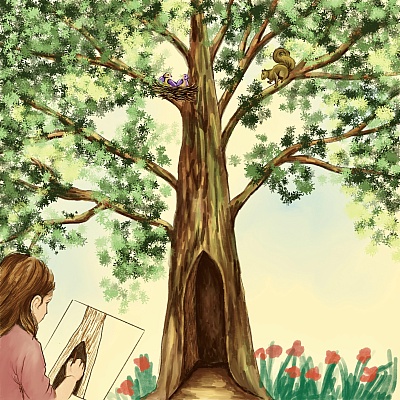
 Growing up, there was a magnificent tulip poplar tree in our backyard. It was close to the house and could be seen from all three floors. My siblings and I were told that when our folks were building the house, the contractor wanted to take it down as it had some sort of disease. Instead, my folks decided to treat it and let it live. The treatment ate away at a good part of the lower trunk, creating a small cave just the size for us children to get into.
As a child, this wound caught my attention. One time, I was drawing a picture of this tree, focused on the dark scar of the wound. When my mom saw it, she sighed.
“Why do you do that? Why do you draw the darkness?’ she asked me. I didn’t know the answer. At that time, it just felt natural to look for whatever was hurt or missing.
As the years passed, the tulip poplar grew far beyond that initial wound, soon reaching 75 feet in height and 16 feet around. It was a happy home for birds’ nests and other little creatures. And every year, the hidden hollow at its base grew a bit smaller.
Though its limbs were too high for climbing, I loved to look at it. After my brother moved out, and when I wanted a quiet space, I often went up to his attic bedroom just to watch the branches and leaves blow about in the wind and a family of squirrels run up and down the trunk.
The tulip poplar eventually reached a height of 150 feet. To encircle it now required five people with open arms. And a dark little opening was all that remained of the small cave.
But for so many years, when I thought about this tree, it was the wound that first came to mind. I remembered how big the hole in the tree trunk had been. How damaged it was. How it almost didn’t make it. Instead of actually seeing this tree, I saw what I remembered was wrong about it.
Decades later, long after I’d moved across the country and had raised my own family out west, I came home for a visit. It was a few months after my dad had died, and I was in the backyard, walking around. I looked up, and it was suddenly like I was seeing this tree for the first time. It stood before me in its full beauty: shapely leaves, spreading branches, and a wide and sturdy trunk. How strong, balanced, and powerful it was!
As I stared upward, understanding washed over me. There is nothing wrong with this tree.
Yes, it had once been hurt, but no longer. It had grown way past that and had healed. In place of that old wound, there was so much beauty. So much strength.
One of the hardest things for me in my life was learning to let go of the past and accept what was true now. Much like the tree, I was wounded in my early years. And for a long time I could only see myself as broken and fragile. But that was only part of my story. I, too, had healed and grown. I’d loved, been loved, learned to forgive, and found greater peace. And standing right there in front of me, this magnificent tree mirrored back all its beauty, well-being, and strength, quietly reminding me of my own.
In that humbling and transformative moment, everything shifted. Not only was there nothing wrong with this tree, there was nothing wrong with me.
Two years later, after Mom passed away, the house was sold. The new owners decided to remove the tulip poplar. They wanted a deck, and unfortunately, this beloved tree was in the way.
I was there a few weeks after it was cut down. I gathered some scraps of bark to honor its life and my sweet memories. As I walked up close to the wide, recently-cut base of the tree, I could see saw marks, but the inner bark, the inside of the tree, was free from any rot or decay. The only lingering sign that this tree had once held a large wound was one very small, dark line. |







Leave a Reply