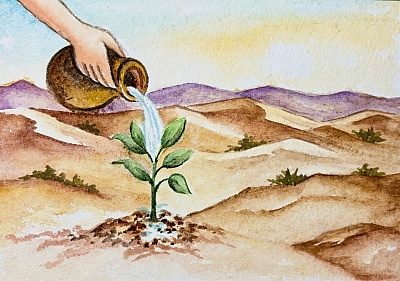
 For what it’s worth, in my world the only thing that truly helps to assimilate all of this into something that moves beyond mere coping to a place of connection is the simple act of getting back to work. For what it’s worth, in my world the only thing that truly helps to assimilate all of this into something that moves beyond mere coping to a place of connection is the simple act of getting back to work.
By this, I don’t mean “work” as the strategic acquisition of wealth, productivity for its own sake, or simply doing more. I’m nodding to something more transcendent than all of that, more intentional and impactful.
This kind of work is about manifesting our purpose, making a contribution, supporting those we care about, creatively turning woe into wonder, adding our voice to the discourse, making beauty and meaning, offering random acts of kindness, making uncredited interventions and notable accomplishments alike, pushing through inertia and barriers, speaking our mind with conviction, going the extra mile, doing what once seemed impossible.
None of this implies that work of this sort needs to happen at a monumental scale to matter.
It can be as simple as cleaning the kitchen before anyone else wakes up, or sprucing up the kids’ rooms while they’re at school — acts that may bring no overt recognition whatsoever. It can be finally cleaning out the garage, painting the fence, planting the garden.
Beyond physical work, there’s also the realm of emotional and intellectual pursuits: starting that meditation class, picking up the old guitar, writing that letter or journal entry or essay, suspending disbelief long enough to really laugh or cry, calling a faraway friend.
At a collective scale, there’s showing up to volunteer, helping a neighbor, raising one’s voice for a cause, supporting local arts in the community, making a climate-friendly life change, sharing something simply for the sake of adding a little splendor to the world.
To me, this is the work of life, of living — what it takes to be both a human being and a human doing.
There is, of course, another meaning of work. Many of us spend much of our lives doing work that can feel alienating, exhausting, or exploitative. At that level, it can be hard to think about “work” as a source of release or connection.
But perhaps that is precisely why the word is worth reclaiming.
There is work we do because we have to, and there is work that somehow returns us to ourselves.
The latter may not look important from the outside. Nobody may applaud the washed dishes, the garden tended, the letter finally written, the friend called, the few minutes spent sitting quietly, the small kindness offered when nobody was watching.
Yet perhaps these acts are not small at all.
When the scale of the world’s troubles feels impossible to comprehend, the work immediately before us makes the massive condensable. It gives our hands somewhere to go. It turns abstraction into participation.
And in doing so, something shifts.
The thing we are working on may change, certainly. The room becomes cleaner. The seed enters the soil. The friend hears our voice. Someone receives a kindness.
But perhaps we are being worked on as well.
What begins as an effort to alter something outside ourselves can become a way of meeting our own helplessness, grief, gratitude, creativity, and capacity for care.
The mundane becomes a place of resistance and recharge.
Maybe this is part of what it means to be alive: not to wait until we can solve the whole thing, nor to imagine that every action must be consequential enough to justify itself, but simply to keep finding the next place where life is asking something of us — and to offer ourselves there.
A meal. A garden. A conversation. A song. A neighbor. A cause. A moment of beauty no one asked us to make.
There will always be more than we can repair. More than we can understand. More than we can carry.
But there is also, almost always, some work of love close at hand.
Let’s get back to it. |







Leave a Reply